
The ō-yoroi — literally “great armor” — is the oldest fully developed form of samurai armor, and the one that most profoundly influenced everything that came after it. Produced from the late Heian period through the Kamakura period, it was conceived for a style of combat based on mounted archery at speed, in which two samurai would pass each other at close range, releasing arrows in rapid succession.
A system built for the mounted archer
From the Nara period (710–784) to the Genpei War (1180–1185), Japanese military organization underwent significant transformations, among them the large-scale introduction of cavalry. Until the 12th century, armor had a plate-based construction not unlike that of other military cultures, but the rise of mounted combat called for new solutions: riders needed cuirasses heavy enough to provide protection and stability, yet built in a way that allowed the arm movement required to draw a bow.
The fundamental premise of the ō-yoroi is that its wearer fights on horseback, primarily with a bow. This constraint shaped every structural decision. The armor is large, boxy, and relatively heavy, and a samurai wearing an ō-yoroi on horseback was protected on all sides from the trajectory of incoming arrows.
At this stage of Japanese history, the military arts were still relatively underdeveloped: large armies did not yet exist, and conflicts were mostly settled through brief skirmishes. We have evidence that in several cases the outcome of a battle was decided by a duel between the commanders of the opposing forces. These samurai, regarded as epic heroes, treated the battlefield as an occasion to display their equipment, which reflected the prestige of the warrior and his family — which is why the aesthetic quality of the armor carried a significance that went well beyond the decorative.
Construction: kozane and odoshi
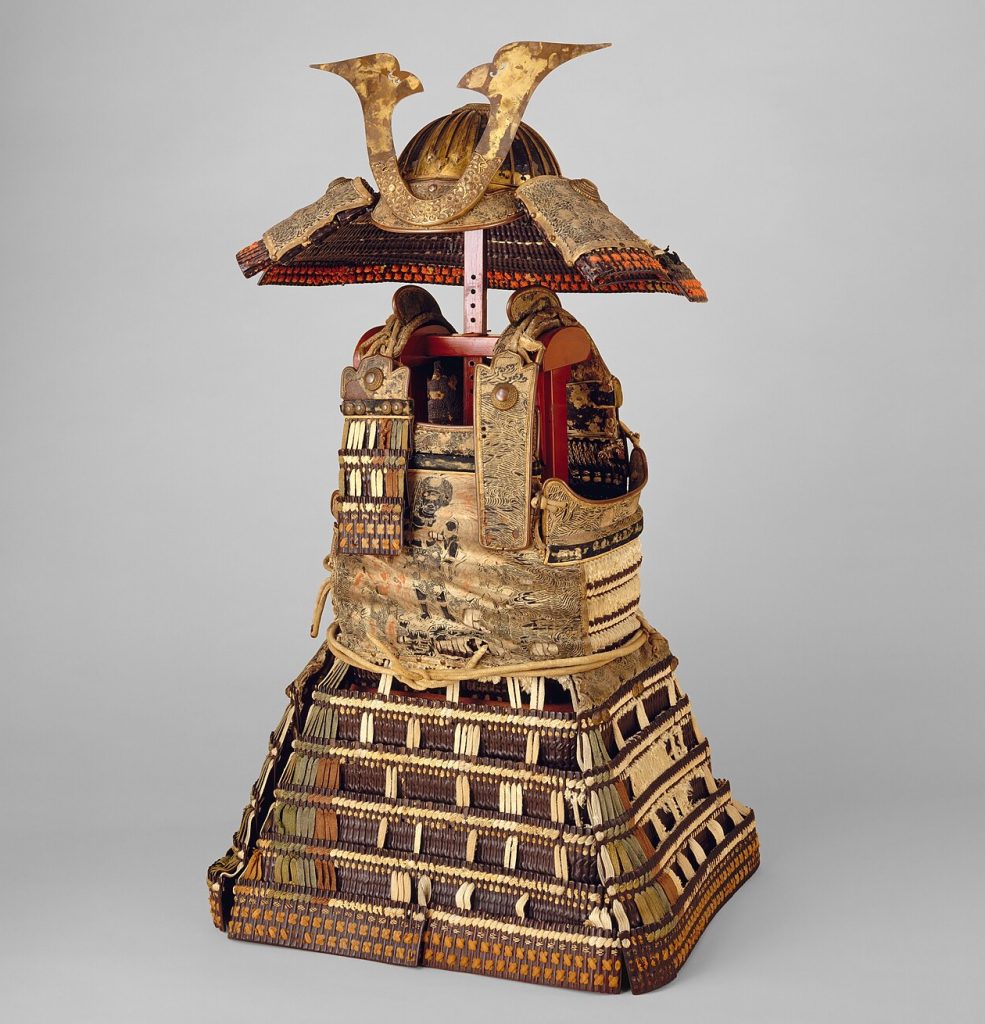
The dō, or cuirass, is the visual heart of the armor. It is built from hundreds of small lacquered iron and leather scales called kozane, laced together with silk cords (odoshi) into horizontal bands — the hon-kozane construction with kebiki-odoshi lacing — which are in turn connected to one another to form a flexible yet coherent surface.
The resulting surface was finished with a layer of lacquer (urushi) to preserve and color the armor. The front of the cuirass, meanwhile, was covered with a decorated leather panel (tsurubashiri) to prevent the bowstring from catching on the scales of the dō.
The components
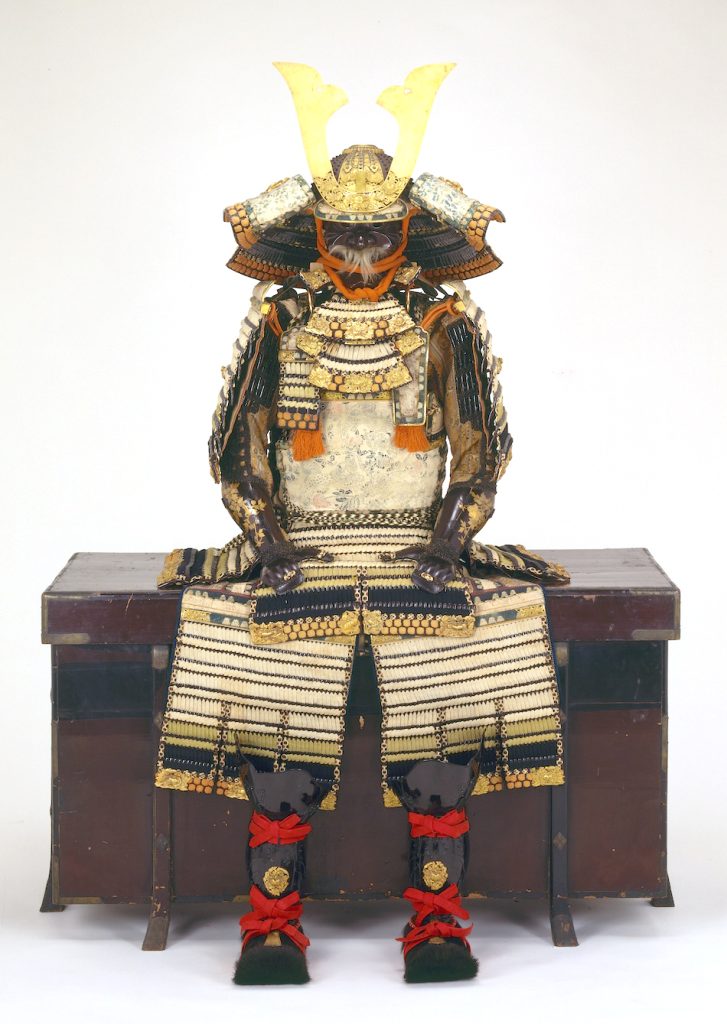
The ō-yoroi always included large ō-sode — the shoulder guards — square in shape and built like shields to protect the sides of the body. The kabuto followed the same logic: the shikoro, the lamellar neck guard hanging from the bowl (hachi), is wide and deep, protecting the neck and shoulders from arrows arriving at varying angles. The uppermost plate of the shikoro also featured two large turned-back panels — the fukigaeshi — which served to deflect blows aimed at the face.
The forearms were covered by kote, armored sleeves combining chainmail with iron plates, and the lower legs by suneate, shin guards of lamellar or solid iron construction.
The aesthetic dimension
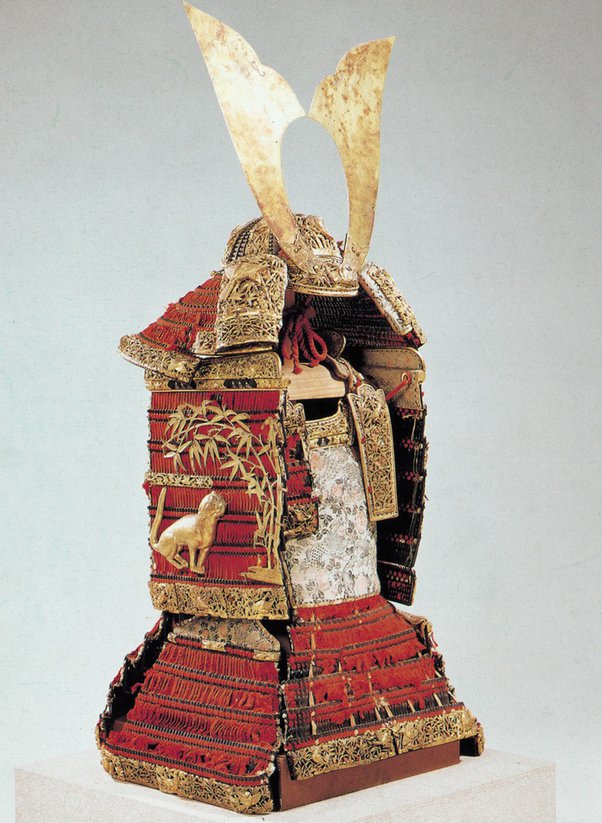
The ō-yoroi was never simply a functional object for the samurai: it is one of the most accomplished expressions of Japanese decorative art. The odoshi lacing — which holds the kozane scales together and connects the armor’s horizontal bands — was produced in an extraordinary range of colors and patterns. The most luxurious examples — such as those preserved at Kasuga Shrine in Nara, decorated with gilt metal appliqué — were not destined for the battlefield at all, but offered as gifts to Shinto shrines as votive objects.
The Mongol invasions and the decline of the ō-yoroi
The ō-yoroi began to give way already from the mid-Kamakura period, but the process was dramatically accelerated by the Mongol invasions. In 1274 the Mongols assembled a fleet that set out from Korea and reached Kyūshū. Once in Japan, their style of fighting was organized into disciplined battalions arranged in phalanxes, armed with swords, spears, and long-range weapons. The samurai were caught off guard: the ritual customs of the warriors, including individual duels and cavalry charges, proved entirely useless against a coordinated regular army. The ō-yoroi had been designed to withstand the violent impact of a cavalry charge, but it proved unusable in foot combat, which required agility of movement. Japanese armorers set to work improving their equipment, focusing on weight reduction and refining the protective plates, paving the way for the models that followed.
Decline, revivals, and legacy
The ō-yoroi, however, never entirely disappeared from collective memory. During the Edo period, armorers produced deliberate revivals for daimyō who wished to evoke the heroic age of the Heian and Kamakura warriors. These pieces — identifiable by their construction techniques and the dimensions of their sode — were objects of cultural memory as much as of protection: a way of connecting the peaceful present to a mythologized past.
Related products
-

Ita-kozane-dō Tosei Gusoku – Samurai armor, mid Edo period
Price: 28.000 € -

Otoke-dō tosei gusoku – Samurai armor, Momoyama period
Price: 45.000 € -

Ni mai dō tosei gusoku – Samurai armor, Momoyama-Edo period
Price: 40.000 € -

Hon-kozane maru-do gusoku, mid Edo period
Price: 45.000 € -

Hon-kozane maru-dō tosei gusoku, Momoyama period
Price: 45.000 € -

Ni-mai-dō tosei gusoku, Edo period
-

Dangae-dō tosei gusoku, mid Edo period
-

Okegawa dō tosei gusoku, mid Edo period
Price: 24.000 €