
Among the most evocative names in the history of Japanese sword art, Nobuie (信家) holds a place of distinction. His tsuba have been admired for centuries for their expressive power and refined simplicity, which make them unmistakable. But who was Nobuie? Why do collectors and museums regard his work as among the most important ever created in the world of tosogu?
The name “Nobuie” does not refer to a single artist, but rather to a signature passed down through several generations of masters active between the Momoyama and the early Edo period. The oldest and most refined pieces are attributed to two—possibly three—masters who lived between the late 16th and early 17th centuries. The first Nobuie likely worked in Owari, during a time when the tsuba began to gain artistic recognition beyond its purely functional role.

Distinctive Characteristics
Tsuba signed by Nobuie are almost exclusively made of iron, and they feature a style that could be described as austere yet powerful. The iron is thick and solid, with surfaces worked in low relief (yakite-shitate) or hammered to achieve a vibrant, tactile texture. The rim is typically raised (uchikaeshi-mimi) or subtly finished. The overall aesthetic reflects a worldview influenced by Zen thought: sobriety, balance, and a profound sense of emptiness.
Decorative elements are minimal and thoughtful: dragons, Chinese figures, landscapes, or calligraphic inscriptions. Each element is carefully calibrated so as not to disturb the harmony of the bare metal. The true protagonist is the iron itself, ennobled by the artist’s craftsmanship.

Nobuie’s Signatures: Futo-mei and Hanare-mei
One of the key elements that define a Nobuie tsuba is the signature (mei) engraved on its surface. Scholars mainly distinguish between two stylistic types, each associated with a different phase of production or with different hands within the Nobuie school: the hanare-mei and the futo-mei.
The term hanare-mei translates as “spaced signature.” In this case, the characters are finer, more widely spaced, and sometimes slightly irregular in alignment. This style is usually attributed to the first-generation Nobuie, active during the late Momoyama to early Edo period, and is considered a hallmark of authenticity and exceptional quality. Futo-mei literally means “thick-character signature”: these are bold, deeply carved inscriptions, with strong, compact strokes that give the signature a visually intense presence. This style is generally attributed to the second (and maybe third) generation.

Nobuie Today: Timeless Charisma and Collecting Appeal
The name Nobuie has become synonymous with an austere yet charismatic tsuba, an object to meditate upon rather than to flaunt. Its technical and spiritual quality has been appreciated not only by warriors of the past but also by modern scholars and collectors in both Japan and the West.
Today, owning an original Nobuie tsuba is like holding a piece of living history. Its beauty is not immediate or ostentatious, but rather grows through slow contemplation—of its aged surfaces, oxidized textures, and the subtle imperfections that tell the story of time.
Related products
-

Haysai tsuba, NBTHK Tokubetsu Hozon Tosogu to Hayashi
Price: 3.000 € -
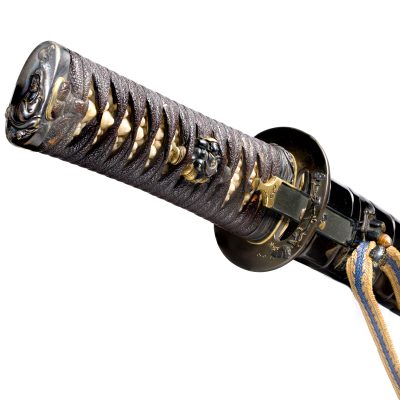
Wakizashi koshirae – Jūyō Tōsogu
Price: 12.000 € -

Tsuba depicting Mount Fuj, Yoshimura Ikkei (1819-1867)
Price: 6.500 € -

Tsuba depicting two trees in the mid-winter, Shōnai school
Price: 3.000 € -

Tsuba depicting wolves under the moon
Price: 3.400 € -

Choshu Tsuba with landscape by Kawaji Tomonao
Price: 2.000 € -

Kazari-tachi – Jūyō Tōsogu, circa 1400)
-

Ressei menpō, Myōchin school samurai iron mask
Price: 7.000 €