
The Umetada school was one of the pivotal centers of sword-related arts between the late Momoyama period and the early Edo era. Founded in Kyōto, it stood out for its versatility and outstanding quality, covering all fields associated with the katana: restorations, horimono, suriage, kinzogan-mei, crafting of habaki, and mountings — most of these works commissioned through collaboration with the Hon’ami family, who retained exclusive rights for polishing and appraisal services.
A fundamental record of the school’s activity is found in the Umetada Meikan, a document that logs over fifty years of commissions carried out by its key members. The text also hints at commercial activity related to the buying and selling of blades.
Paradoxically, although the school’s — and particularly Myōju’s — current fame is primarily tied to blades and tsuba, it is highly likely that these were originally marginal productions, intended more to satisfy the refined tastes of friends and family than to fulfill official commissions. Among the most representative names, we recall two first-rate artists, Mitsutada and Myōju, accompanied by two excellent craftsmen, Myōshin and Jusai, as well as another significant figure: Hikobei.
Umetada Myōju
Myōju was a profoundly innovative artist, endowed with extraordinary taste and technical curiosity, capable of blending classical references with bold experimentation. His tsuba stand among the highest artistic achievements in the history of tosōgu.
According to family genealogy, he was said to be the twenty-fifth direct descendant of Sanjō Munechika (10th century), who lived in the Sanjo district of Kyōto, in an area called Ume-ta-da (“plum field”), from which the family name was derived. A legend holds that in 1416, the Emperor ratified the transcription into the kanji Umetada, also granting a family kamon featuring a wave inside a circle.
Myōju was born in 1558. His birth name was Hikojirō, later changed to Shigeyoshi and then Muneyoshi. Around the age of forty, he took monastic vows and assumed the name Myōju. A blade he signed at the age of 61, dated Genna 4 (1618), indirectly confirms his year of birth. The primary sources regarding his life and work remain the Umetada Meikan and a small yet precious corpus of signed and dated blades, four of which also record the artist’s age — a particularly rare detail.
 Trained as a horimonoshi (blade carver), Myōju possessed a high-level technical foundation that, contrary to the assumptions of some scholars, enabled him to craft tsuba personally. His oeuvre can be divided into two distinct stylistic phases:
•The first, in iron, is heavily influenced by the Ko-Shōami school and features nunome-zōgan inlays with geometric patterns — key-frets, lozenges — in gold. While the style is relatively conventional, the craftsmanship is extraordinary. This period also includes tsuba closely related to Mitsutada, who may have served as Myōju’s teacher.

•The second phase begins around 1619, when Myōju moved to the village of Takagamine, founded by Hon’ami Kōetsu — a central figure in the emerging Rinpa school. Here, the artist developed a completely new idiom, inspired by Rinpa painting, using soft metals like sentoku with modeled surfaces rich in irregular niku and vegetal decorative motifs (oak, grapevine, bergamot). This marked a shift toward a more liberated and sumptuous aesthetic, in keeping with Momoyama taste. Kōetsu’s influence was decisive, as were those of Tawaraya Sōtatsu, Gotō Kōjō, and the textile artisans of the Nishijin district, where Myōju’s workshop was located.
His tsuba are often large and nade-kaku gata in shape, with uchikaeshi-mimi or kaku-mimi rims, depending on the material. He worked in iron, shakudō, suaka (copper), and a particular type of brass (sentoku) treated using the kusarakashi technique, employing an acid solution to create a reticulated texture resembling ji-yasuri. Following this process, the hira-zōgan inlays appeared smoother and slightly raised, visually resembling maki-e lacquerwork (sumi-e zogan). A distinctive feature of many of his tsuba is the diagonal beveling around the nakago-ana, on the signature side.


His most common signature is in yojimei (four kanji), distributed on either side of the seppa-dai, with “Umetada” on one side and “Myōju” on the other. In some earlier examples, only “Umetada” appears. It is likely that the artist reserved his personal name for his finest works, affixing the generic school name to lesser productions — a practice also common among other masters, such as Mitsutada. Interestingly, no tsuba signed as “Shigeyoshi” or “Muneyoshi” are known, although these names appear on some blades. It is thus plausible that pieces signed simply “Umetada” are his, created before he took monastic vows.
Related products
-

Haysai tsuba, NBTHK Tokubetsu Hozon Tosogu to Hayashi
Price: 3.000 € -

Tsuba depicting two trees in the mid-winter, Shōnai school
Price: 3.000 € -
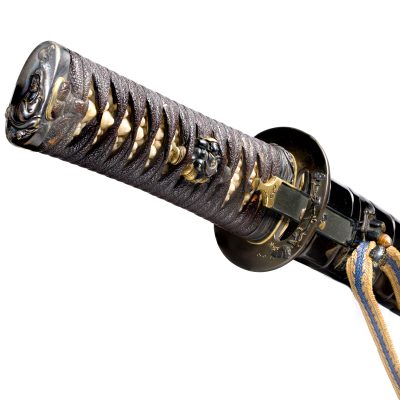
Wakizashi koshirae – Jūyō Tōsogu
Price: 12.000 € -

Higo Koshirae, Hirata school completed mounting
Price: 28.000 € -

Tsuba depicting Mount Fuj, Yoshimura Ikkei (1819-1867)
Price: 6.500 € -

Tsuba depicting wolves under the moon
Price: 3.400 € -

Choshu Tsuba with landscape by Kawaji Tomonao
Price: 2.000 € -
![A pair of two-panel screens, Rimpa school [each 159 x 161 cm]](https://www.giuseppepiva.com/wp-content/uploads/2025/03/byo387-rinpa1-Modifica-1280x570.jpg)
A pair of two-panel screens, Rimpa school [each 159 x 161 cm]